The authentic and timeless world of Ralph Lauren
Spring 2026
RL/Culture

The Constancy of Pinstripes

A mother and daughter bond over baseball memories across the years.
By Bridget Foley
A kid stepped up to the plate. He’d done so hundreds of times before, from his grade-school days. Yet this would prove to be a first for the ages—his first Major League at-bat. He faced his first Major League pitcher, who threw him his first Major League pitch. He took his first Major League swing and swiftly slammed the ball out of the park, his first foray into Major League lore. That kid was future deity-in-pinstripes Aaron Judge, making his Major League debut at Yankee Stadium, on a sweltering day in August 2016.
The author (left) with her daughter, Gráinne.
The game offers no guarantees, but always, a wellspring of hope.
My daughter Gráinne and I were there for the magic, which hindsight has elevated to myth. In that moment, no one could have known that that Aaron Judge, the towering post-adolescent who after the game called playing for the Yankees “a blessing and honor,” would become the Aaron Judge. Sure, he was a dream prospect. But lots of dream prospects fizzle out. This is baseball, the domain of mercurial gods. No one could have known with certainty that Judge would smash records while proving himself a worthy successor to Monument Park’s litany of legends, from Babe Ruth to Reggie Jackson to Mariano Rivera and especially, to Derek Jeter. But he has done just that, securing a prominent place in the grand historical continuum revered by the game’s most staunchly purist devotees. As Brad Pitt’s Billy Beane said (via Moneyball screenwriters Aaron Sorkin and Steven Zaillian), “How can you not be romantic about baseball?” A corny line, sure. Corny, cheesy, trite. It’s also true. Romance courses through baseball. It’s a game steeped in the broad strokes and minutia of its history, its structure not bound by time but designed so that even its greatest stars fail more than succeed.
TIMELESS
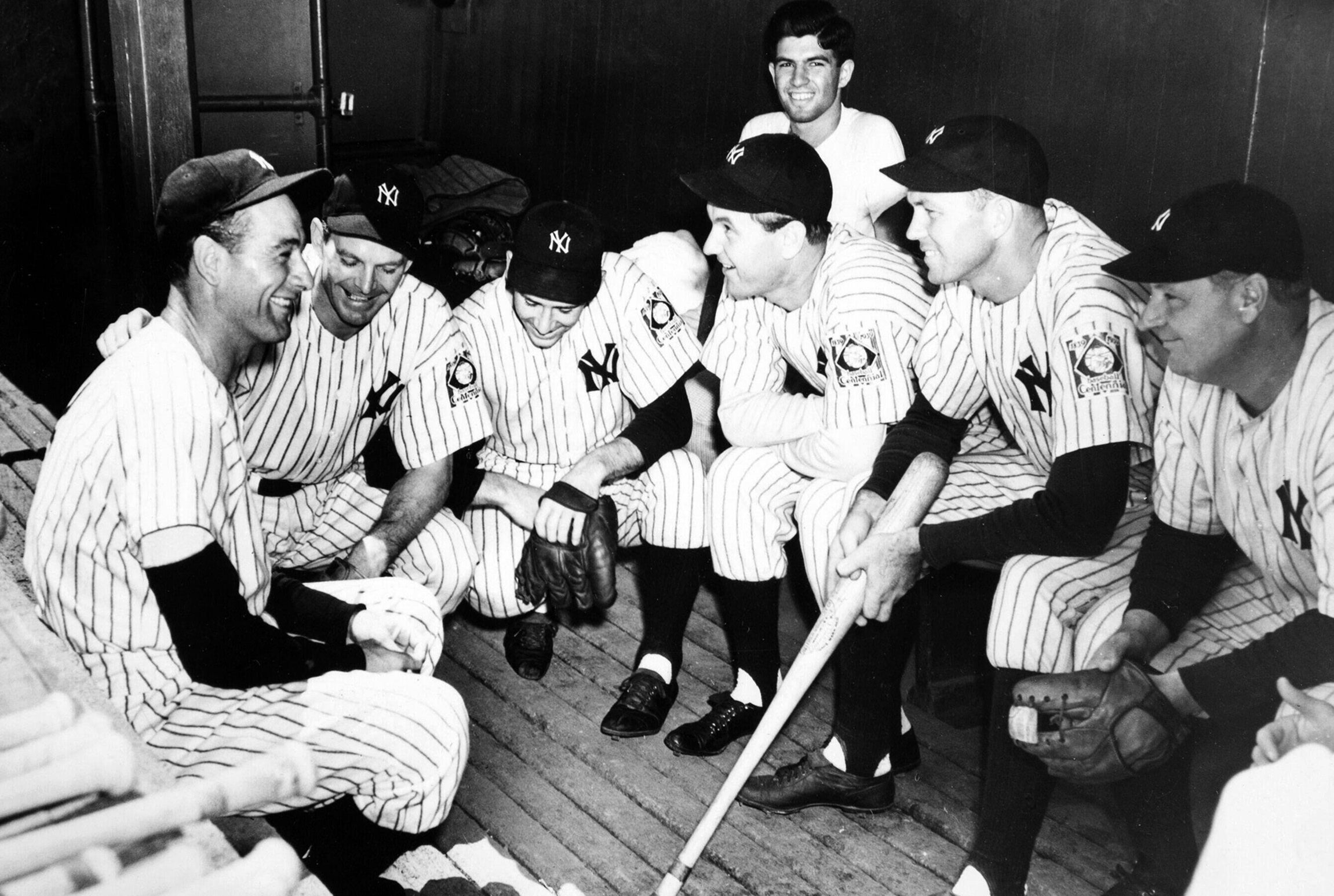
Lou Gehrig, the Hall of Famer who held the major-league record for most-consecutive games played, chats with Yankee teammates in 1939.

Baseball both revels in that romance and fights to counter accusations of old-timey inertia. This year, for the first time, the Majors allows teams to challenge balls and strikes, with disputes settled by an automated system. The game’s sacrosanct human element is no longer absolute. Such tech-era intrusion was only a theory when Judge made his debut on that day in August 2016, when it just so happened the Yankees were marking the 20th anniversary of their 1996 World Series Championship and the team that ended a 17-year championship drought. Ten-year-old Gráinne and I were in Yankee Stadium for that moment, as well—a favorite shared memory of her childhood. How could we forget it? The Bombers found themselves in a hole, opening the series 0-2, before winning the third game. In Game Four, against the Atlanta Braves, they faced a seemingly insurmountable 6-0 deficit. Yet in baseball, with no ticking clock, you battle only your opponent and your inner demons. The Yankees fought back fiercely, not only winning Game Four, but Game 5 as well. That’s when the stage was set for what would become a magical Game 6.
A decade into his brilliant tenure, Aaron Judge has assumed Atlas status.
Gráinne and I had our own cosmic wonderment. Her father/my ex-husband, got great tickets and, though a proud Bronx native, gave them to me. (Great as in behind-home-plate, two-rows-in-front-of-Jack-Nicholson great.) But timing posed a conundrum. Back then, the New York fashion shows were held in late October, and as fate would have it, one was a show scheduled for 7 p.m.—on the same night as Game Six. As lead fashion critic for WWD, I knew my priorities. Fashion came first. But the Yankees led the series 3-2. Gods willing (God-God and baseball gods), they would win it all in six. So, a query to my boss, Patrick McCarthy: “How would you feel if I skipped the show?” Patrick: “Not good. But I will get you a car to take you to the Bronx after the show.” The second it ended, I raced out of the Bryant Park Tents, into my waiting town car and home to pick up Gráinne. Then, off to the stadium, the old one. The House That Ruth Built. We missed 8-year-old anthem chanteuse/team good luck charm Christina Skleros, the first inning, and part of the second. But we were there for all the scoring and ample revelry. In short, the Yankees won. Frank Sinatra crooned. Wade Boggs rode a police horse. And the communal anticipation, anxiety, and ultimate elation of 56,000 euphoric fans engulfed our mother-daughter intimacy. The heady reverie initiated a sports-outing tradition for us; we would try to hit one “meaningful” game each season. Hence, our 20th anniversary sojourn. Of course, in reality, time doesn’t stand. It sprints. Dreams become aspirations, and aspirations, challenges. We realize our goals, or we don’t. Along the way, we look to our sports teams and heroes, not for vicarious thrills, but shared victories. A decade into his brilliant tenure, Judge has assumed Atlas status, carrying on his shoulders the oppositional weights of eager expectation and impatient longing, for a 28th championship, so far elusive. As fans, we’re silently on edge, with precedent. Elders remember, and younger fans have learned, the fate of Don Mattingly, the greatest Yankee denied a ring. We want Judge’s ring, for him and for us. The game offers no guarantees, but always, a wellspring of hope. How can you not be romantic about baseball? Indeed.

Bridget Foley is a longtime fashion critic and baseball enthusiast. She is the author of Ralph Lauren Catwalk, out this spring from Thames & Hudson.