


The authentic and timeless world of Ralph Lauren
Spring 2026
RL/Culture

On the Fly

How the author’s running habit helped him write a breakout novel.
By Tommy Orange
Photo: John D. and Catherine T. MacArthur Foundation
FOLLOWING THE PATH
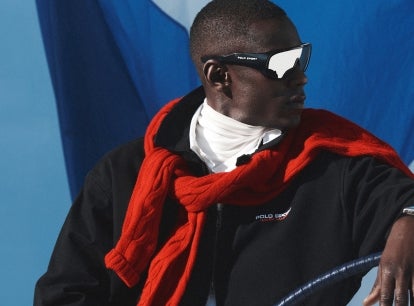
The author, above, whose novel There There was nominated for the Pulitzer Prize in 2019, and, below, when roller hockey was more important than writing.
The first time I tried going on a run by myself, as an activity, to get in better shape, was 20 years ago. I had a yellow-and-black Walkman, a cassette tape player, but no running shoes. I lasted probably 20 minutes, and I hated every second of it. Before that, I knew running only as a punishment our soccer coach handed out at practice. If I was in an actual game, running never felt like running. It was part of the fun of playing.
Photo: John D. and Catherine T. MacArthur Foundation
FOLLOWING THE PATH
The author, above, whose novel There There was nominated for the Pulitzer Prize in 2019, and, below, when roller hockey was more important than writing.
When I was 13, I ended up landing on roller hockey as my sport of choice. As something which required zero running, it almost seemed to prove running an inferior mode of movement. I joined a travel team coached by an ex-marine, who made us run to step up our stamina and speed. A few of us hated it so much we ended up sneaking onto a free airport shuttle that was near the hockey rink in order to get back. Eventually, we got caught, which led, of course, to more running. At 16 I got sponsored by a company. There was a professional sports team out of Oakland, where I grew up, called the Oakland Skates. It was what I wanted to do when I grew up. And then the sport died. I found art, first in music, and then eventually in writing. I don’t remember when I first knew running could be helpful to generate ideas I wasn’t able to find at the writing desk. I do remember the feeling I’d had, though, while sitting on the bench during hockey games, that some part of my brain was becoming more active when I was in that state, breathing hard between shifts, thinking about the game and the players and what I was going to do better when I got back out. I didn’t learn to love running until I lived near Lake Merritt, in Oakland, and began running the lake every day after work. But I got stuck at 3 miles for a long time. When we moved again—this time to the foothills of the Sierra Nevada mountains—I started adding miles, and it wasn’t until I added those miles that I found that I was writing while I was running, taking notes as I pushed through 5 and 6 miles in 100-degree weather, finding thoughts I didn’t know were there, just past what I’d thought until then was my limit.
Who’d have thought you do your best thinking when you most think you’re not thinking?
What came to me felt like undeniable solutions to deep structural problems I was having with There There, my first novel, popping right into my head when I didn’t even think I was thinking. Who’d have thought you do your best thinking when you most think you’re not thinking? The idea of having mini chapters after the interlude which would then reappear as the structure at the end of the book—that all came to me on a run. Still, there’s no real trick to getting into a space where you write exactly what you need to write. It’s a messy, grueling, time-based commitment, where—if you can—you put yourself in the position to capture the thing you sense is somewhere inside you, that you sense is also inside the reader, a story you know will be understood and felt if you can get it just right. If you found a way to access that part of you that thinks best, maybe not every time you went at it, but enough of the time, wouldn’t you do anything you could to access it? In the Coen brothers movie Burn After Reading, there’s an obsessive character played by George Clooney, who has recurring lines about having to get a run in, just a casual 5 miles in the middle of his day. That’s kind of my approach. I run an average of 5 miles a day. Some days I run 13, usually broken up into two and sometimes three runs. Other times it’s 7 or 8 miles. The average is 5. As I write this, I’m planning a 27-minute run before I have to go pick up my son from preschool. The kind of thinking I do when I run is the same as the kind people do when they say they’ll sleep on it. Letting problems I can’t figure out drift into the background while I push through more miles, I wait to see if something comes. It reminds me of the flying dreams I had a lot as a kid. They were my favorite dreams to have. I think the dream of flight is related to not having to carry what weighs us down, our bodies, our worries, the troubles of the world. At some point I realized writing was a way to do the same, to lift the lid on so much I normally don’t want to have to think about or feel. Lately, I’ve even been having dreams where the two things merge—a run turns into a kind of flying. It makes sense. To me, running is about losing yourself completely in the act, disappearing while being completely present all at once, a kind of prayer, or devotion, an act of faith, much like writing, where you show up and wait to see what it has in store for you, running after it and letting it come to you.

Tommy Orange is the author of There There, a novel that was a finalist for the 2019 Pulitzer Prize.