The authentic and timeless world of Ralph Lauren
April 2026
RL/People

Pure Drive

One of golf’s greatest champions talks about loving it, hating it, and winning it all.
By Jay Fielden
Before I realized I wanted to be a writer, I dreamed of making it on the PGA Tour. I was around 9 when my grandfather first put a club in my hands to teach me how to swing it one evening in his backyard as the West Texas sun went down. Long after the soda lights blinked on, I was still out there with the mosquitoes, using my shadow as a guide to trace the proper form he’d shown me. Somehow, I found it entertaining, even without a ball. And once a ball did come into the picture, that was it. Golf was almost all I thought about. And my favorite golfer who played it—Tom Watson, who I watched on television and read about in Golf Digest. Was it the auburn shock of hair, his easy, gap-tooth smile, the husky flat vowels of his Missourian upbringing, which sounded a bit more serious than the spaghetti Western of dipthongs I was used to? I think it was all that, plus the rhythm and balance of his enviable swing—the one that won him eight majors, including one of the most famous finishes in U.S. Open history, two green jackets, and the Claret Jug five times. Let’s not discount his classic, saddle-shoe sense of style, either—surely, the younger me noticed. Earlier this spring, I reached him by phone at his house in Scottsdale, Arizona, before he was headed out to play one of his frequent pickleball matches. “I try to play everywhere we go,” he said, before adding, “If we can find some decent competition.”

Watson’s Favorite Off-the-Beaten Scottish Tracks

Shiskine,
Isle of Arran

“A true links course. Played the little 12-hole golf course with rented clubs and street shoes—I love that.”

Machrihanish,
Kintyre Peninsula

“A course I always wanted to play.”

Tobermory,
Isle of Mull

“It’s a wonderful place, an island just south of Skye—a leeward port right off the Atlantic Ocean.”

Golf as a sport is like a family heirloom—it gets handed down. Is that how it was for you?

Golf Digest did a survey back in the ’70s, I think. They asked all the golf professionals they could, who started them in the game? Something like 80 percent said that it was their dad. It was a family-inspired sport for me, too. My dad would take me and my older brother to the Kansas City Country Club. He was a very fine golfer—he played in the national amateur a couple times—and he taught us the fundamentals of the game when I was 6 six years old. Keep your head still, turn your back to the target on the back swing, and—the most important thing!—finish with your belly button facing the hole on your follow-through.

You’ve now been playing the game for 70 years. Did you ever get sick of it?

Yeah, when I was playing lousy on the tour, I sure did. There were a couple of times I didn’t touch a club for six weeks. One day, struggling with the swing, I remember cursing to my old pro, Stan Thirsk. “I hate this friggin’ game!” I said. “Yeah, yeah,” he said, “You really hate it, don’t you?” “Yeah,” I said, “I really hate it!” He just looked at me. “Don’t worry,” he said, “the worm will turn.” Of course, he was right. It did.

This year’s U.S. Open is being hosted at Shinnecock. What’s the secret to winning there?

It’s a tough golf course. It has a lot of really, really, precise shots you have to play well. The 9th, the 10th, the 11th—if you don’t play those three holes, you have no chance at winning.

You’ve been a Polo Golf ambassador since the early ’90s. How would you describe your own personal style?

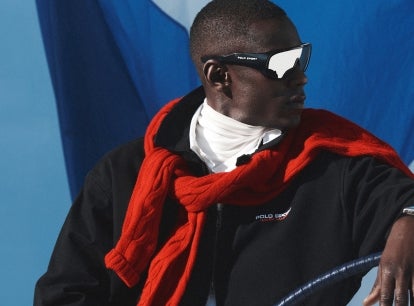
Tech materials have changed the style of the game. The Tour’s gone to the casual Friday look, rather than the more formal, classic look I prefer. I’m old school, but that’s the great thing about Ralph—he combines the two very well. I wouldn’t be caught dead without saddle shoes, OK? And I’m a cashmere sweater guy, because they come in different gages to keep you warm in different weather. Obviously, Ralph’s got plenty of those.

I know you’ve probably got a pickleball match or something to go to, so let me ask you one more question. What’s the importance of having a real rival—in your case, Jack Nicklaus?

Well, I always had a rival. I mean, when I was growing up, my rival was my older brother, Ridge. He was three years older, bigger, stronger, hit the ball farther, and I was always trying to beat him. When I was a kid, I thought Jack was a villain for beating my hero, Arnold Palmer. Once I got on tour, Nicklaus was the man to beat.

The two of you had a lot of battles, perhaps most memorably in the 1982 U.S. Open at Pebble Beach, which came down to the last two holes. How’d you do it?

Going into the tournament that year, I was playing my worst golf. I was just awful! During the practice rounds, I kept trying to find some gimmick that was going to help my swing. But nothing did, so I decided to practice chipping the ball a lot from just off the green on the down slopes. The first two rounds, I was so off-line, I was literally hitting the ball into the gallery, but I caught a break because the heavy rough had been trampled down. Through smoke and mirrors, I was somehow even par going into the weekend. I went straight back to the practice range on Friday afternoon, still searching for that gimmick, when I remembered a tip that Sam Sneed once gave me about keeping my left arm close to my chest on the back swing. And, well, it worked! I hit just about every fairway in the final two rounds. I also putted the eyes out. And, of course, that lucky chip went in on 17. I guess all the short-game practice proved to be a pretty good strategy.
PERFECT MATCH
Watson has been photographed as a Polo Golf Ambassador since the early 1990s. In 1982, above, he secured his victory at the U.S. Open by chipping in from the rough on 17.

Before you holed that shot, you were tied for the lead with Nicklaus. How’d you calm your nerves?

You stick to what you’ve been trained to do. Keep the pressure within a certain limit. You need enough to keep your edge, but not too much that you lose it. So, you walk at a slower pace, breathe deeper, even yawn. You have to fill your lungs with air, because, what is choking? Breathing shallower. And to fill your lungs with air helps relax you.

I guess it wasn’t your first rodeo—

One summer, my father took us on a family vacation to Colorado. On our way back, we went by a course he wanted to play. So, we stopped the car and got the clubs out and dad goes in to pay and the guy, he says, “Well, how old is that kid?” “Eight,” my dad says. “Oh, he can’t play—he’s too young.” My dad was an insurance salesman, so he starts negotiating. “I’ll tell you what, if my son can hit it over that creek off the tee there, can he play?” The man looks at me. “Alright, I’ll give him that.” I thought, “Oh, gosh.” But I busted it out there about 125 yards down the fairway and over the creek. I guess that was my first bout with pressure on a golf course.

JAY FIELDEN, the former editor of Esquire, Town & Country, and Men’s Vogue, is a writer and poet.