The authentic and timeless world of Ralph Lauren
April 2025
RL/Culture

Rolls-Royce Radical

Sixty years ago, an old money scion with a rebel streak created a scandal at one of the oldest tennis clubs in America. His grand faux pas? Changing the way the game is scored. The eventual result? A fundamental improvement in the modern game
By Darrell Hartman
Revolution was in the air in 1965—in Newport, Rhode Island, of all places. That July, Bob Dylan shocked the music world by going electric at the Newport Folk Festival. Meanwhile, just down the street—and still unbeknownst to many—a decidedly preppier disruptor was facing down his own chorus of protest for daring to question the quaintly eccentric math used to score an afternoon game of tennis. Jimmy Van Alen, the irrepressible president of the Newport Casino—a grand Shingle Style tennis club designed by Stanford White in 1879—had stunned the old guard with an outlandish experiment that would eventually help reshape the game into the spectacle it is today.
SPORTS ILLUSTRATED
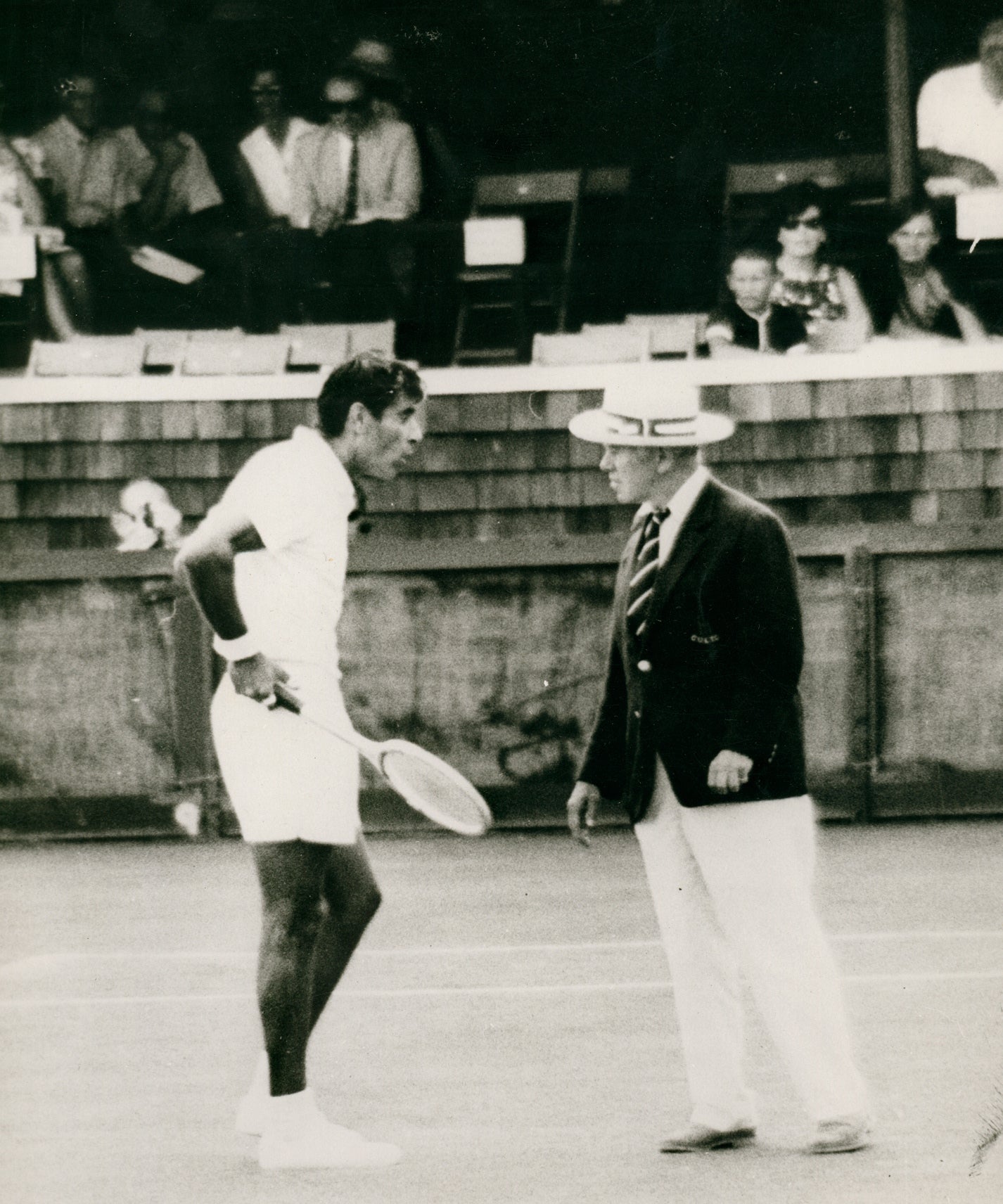
Top, Jimmy Van Alen stands before the scoreboard at the revolutionary 1965 tournament; above left, a cartoonist’s depiction of Jimmy Van Alen scolding Pancho Gonzalez for unsportsmanlike conduct that same year; at right, the conflict, photographed.
SPORTS ILLUSTRATED
Top, Jimmy Van Alen stands before the scoreboard at the revolutionary 1965 tournament; above left, a cartoonist’s depiction of Jimmy Van Alen scolding Pancho Gonzalez for unsportsmanlike conduct that same year; at right, the conflict, photographed.
From the 19th century to the mid-1960s, the game’s power lay with the exclusive country clubs that hosted prestigious tournaments and the national associations that sent players to them. The rules, per genteel tradition, stipulated that all these players be amateurs, which required either tapping a trust fund or scraping by on under-the-table payments that sometimes earned them the moniker “shamateurs.” Professional players—including legends-to-be like Rod Laver and Stan Smith, both of whom needed to earn a living—were barred from all the great competitions, from Wimbledon on down. They rode a scrappier circuit, playing mostly exhibition matches at public courts, high-school gymnasiums, and hastily converted hockey arenas. Unsurprisingly, the pros were unwelcome at the Casino, whose manicured lawns were a throwback to a time when the sport had belonged to the leisure class and been nearly as rarefied as polo. But Van Alen wanted to change who played tennis and how it was scored—and he had the pedigree and the panache to do it.
HOLDING COURT
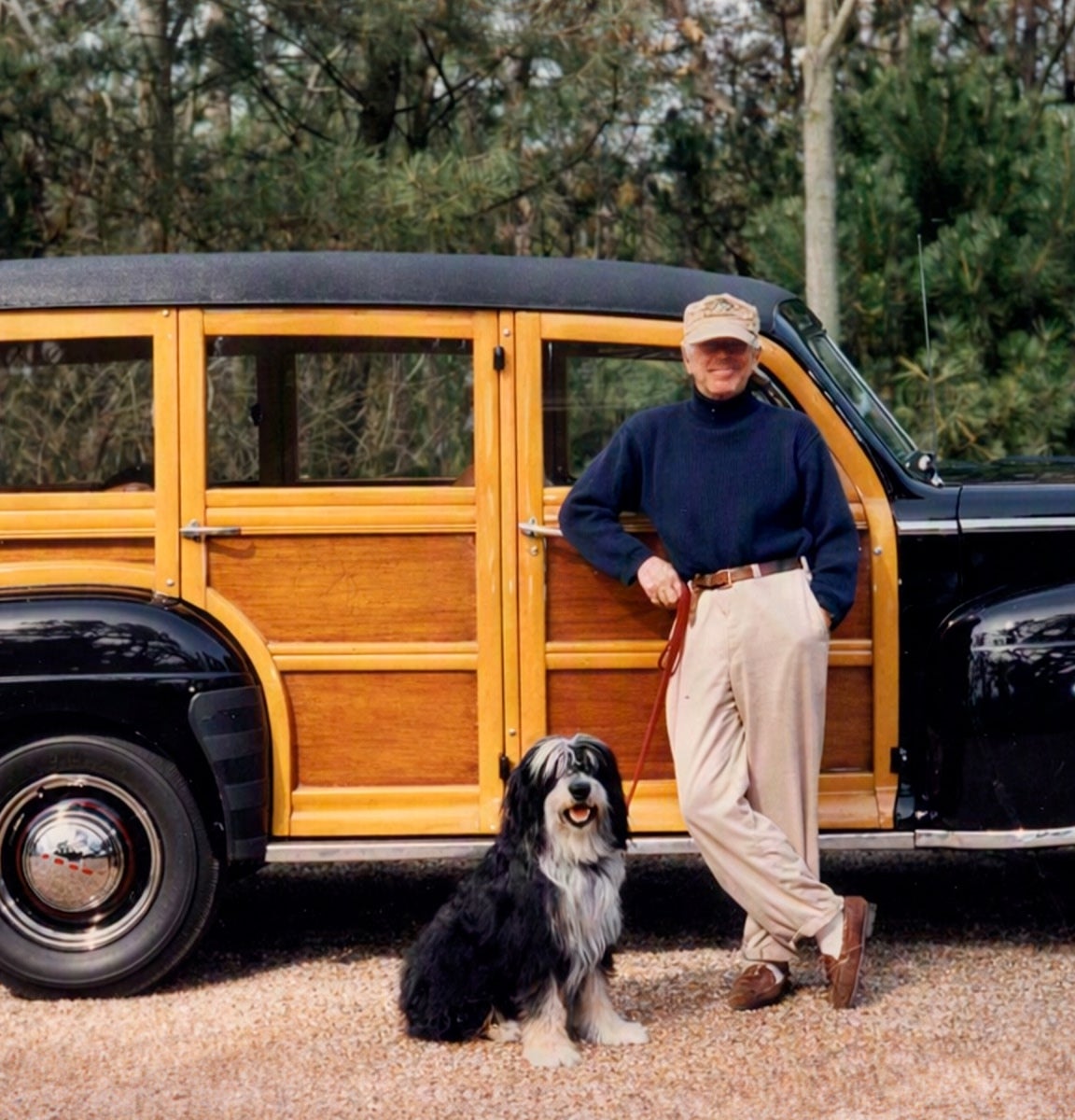
Top, the well-manicured lawn of what was then known as the National Tennis Hall of Fame; above, Van Alen in his later years.
James Henry Van Alen II had been born into a life of moneyed privilege. His great-grandfather founded the pharmaceutical and dry-goods business that created Vaseline; his mother was an Astor and Vanderbilt heiress. Young Jimmy, who was born in 1902, grew up spending summers in one of Newport’s so-called “cottages,” a 30-room estate his grandfather had built in 1887, and developed a typically aristocratic range of interests—horses, shooting, sailing, poetry, music, pranks. He never found a paid vocation after graduating from Cambridge, or needed to. He got into and then out of banking, wrote op-eds, and for a time had an office at a New York City publisher where he put in a gentlemanly one hour of work a day. Around Newport, he was a princely personage, striding about in a bow tie and straw boater. He occupied the family’s ancestral mansion with his wife, Candy, and aging mother, Margaret “Daisy” Van Alen Bruguière. The property was the last grandly run private house in town, complete with liveried footmen and a candlelit entrance hall. The son of the house drove a yellow Rolls-Royce with a custom-made “VA” hood ornament. “Van,” as he was known, had enough self-assurance—and free time—to turn pet interests into long-shot crusades. He once tried to propagate the English robin in America as an alternative to the “disgustingly bosomy” native species, an illegal project that failed quickly. His lifelong passion, however, was tennis. He captained the Cambridge team as an expat student in the 1920s and competed heartily at court tennis, aka “real tennis,” an older version of lawn tennis played at only a handful of elite clubs and schools. While in his 30s, he won the U.S. championship three times. Tennis is where he would make his greatest mark, beginning with the preservation of the Newport Casino. The storied club, which had hosted the U.S. national singles championships between 1881 and 1914, had fallen into disrepair by the mid-20th century. Inspired by a trip to the National Baseball Hall of Fame in Cooperstown, New York—that sport’s Valhalla—Van Alen, now the Casino’s president, spearheaded both its renovation and conversion into the International Tennis Hall of Fame. Though it would take years for the museum to get on firm financial footing, it had glamour from the outset: At the inaugural ceremony in 1955, Grace Kelly handed out the trophies.
As president, Van Alen also ran the club’s famous summer tournament where he saw room for improvement. Casual fans were confused by tennis scoring, which leapfrogs from “love” to 15, 30, and 40, and then (sometimes) “deuce” and “advantage.” Every game had to be won by two points, and every set by a margin of two games. A 7–5 or a 6–4 set was (and still is) a close one; but during this pre-tiebreak era, sets could (and did) end up at 32–30 or 19–17, at the risk of boring spectators or—worse!—delaying cocktail parties. In 1954, a singles match on the Casino’s main court ran 3.5 hours, forcing a more important contest to be played on a side court. Van Alen, fuming, decided there had to be a better way. He called it the Van Alen Simplified Scoring System, or VASSS, and it eventually took several forms. One of them scored each game 1–2–3–4 (with the first to reach four points winning the game) and called for sets that were locked at 6–6 to be settled by a nine-point (i.e., first-to-five) tiebreaker. Van Alen’s preferred version was more radical: The first player to 31 won the match, with the server changing every five points, as in ping-pong. Both variants did away with the “advantage” scoring that could extend deuce games interminably. Van Alen argued that VASSS made it virtually impossible for matches to exceed 70 minutes—which was, he explained, “just about as long as I care to watch people play tennis.”
RULES OF THE GAME
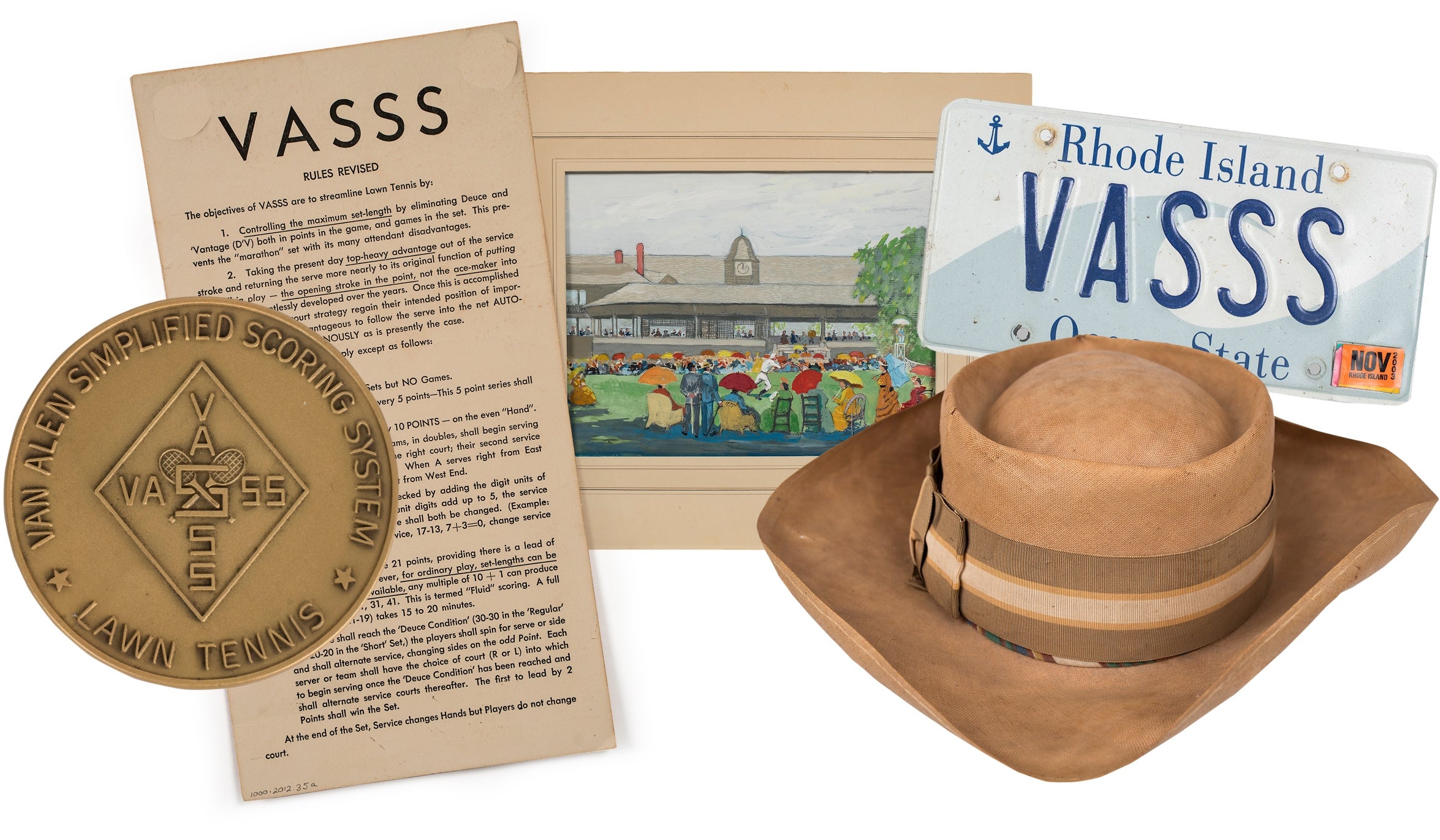
Top, an early tournament at the Newport Casino tennis club; assorted memorabilia from JVA’s storied life, including his infamous scoring system and iconic license plate.
RULES OF THE GAME
Top, an early tournament at the Newport Casino tennis club; assorted memorabilia from JVA’s storied life, including his infamous scoring system and iconic license plate.
The federations overseeing amateur tennis rejected the untested new scoring method on principle. Van Alen ignored the snorts of derision and promoted his solution with gusto. “Jimmy was a forceful character, a big personality—very dogmatic, very pushy, but fun to be around,” recalls Richard Evans, who covered tennis for London’s Evening Standard throughout the ’60s. “He certainly didn’t look like one—in his blazer and tie, he looked like a New England sporting gentleman—but he was very much the revolutionary,” adds Evans, who would go on to become the first PR director of the Association of Tennis Professionals, the governing body of men’s pro tennis. Van Alen, knowing that the pros were generally up for anything that involved tennis balls and a paycheck, offered a group of them $10,000 in prize money to come to the Casino and serve as PR-friendly guinea pigs. Most had played there before, in their amateur days, and among spectators, at least, their presence raised fewer eyebrows than Van Alen’s other gimmicks. He had done the math so that each point was worth $5. An electric scoreboard—another novelty—kept a running tally of each player’s winnings, as on a TV game show. For one of the first times ever, courts were lit after dark. Van Alen also moved the serving distance back 3 feet from the baseline in hopes of making the points more interesting.
CASINO ROYALE
An afternoon in 1915 at the Newport Casino tennis club, which was designed by Stanford White.
CASINO ROYALE
An afternoon in 1915 at the Newport Casino tennis club, which was designed by Stanford White.
The players’ response was mixed: The winners—including Laver that first year—quietly accepted the changes; the losers grumbled. The VASSS Pro Tennis Championships was successful enough to run at the Casino for the next five years. But Van Alen’s best hope for widespread adoption lay with the TV networks. The expansion of tennis hinged on live broadcasts, where the wild unpredictability of match length was considered problematic. “Nothing would hasten wide acceptance of Van Alen’s brainchild so much as a fat television contract,” The New York Times noted in 1966. But despite some interest at ABC, no such contract materialized. One element of VASSS did gain a foothold, though: the sudden-death tiebreaker. Van Alen’s nine-point version (in which the first to five points wins the set) was used at the US Open between 1970 and 1974. At Forest Hills during these years, red flags were unfurled during sudden-death moments. “You’d see the flags if you were walking by and you’d know,” recalls Stan Smith, winner of the 1971 men’s title. “It added some drama to the situation.” This primitive tiebreaker felt gladiatorial, partly because it enabled a whole championship (not just a set) to come down to a single do-or-die point. If a set was tied at six games all, and the tiebreaker score was 4–4, the next point won the set. In the past, exhausted combatants had been permitted to bob and weave until the end, but now they were effectively being held in place and forced to deliver a knockout punch. A perfectly even title match could end with a ball caroming off a bald patch or dribbling over the net tape. (Today, tiebreakers of any length must be won by two points.) The prospect delighted Van Alen. “The pressure in sudden death has produced a new dimension—none of the old estimates hold true,” he wrote in a letter to his fellow advocates around this time. “Anything can and does happen—it divides [the] men from the boys as in the Colosseum in Rome.” But the players found it too stressful, even unfair. “I remember Rod Laver being so upset about it,” recalls Butch Buchholz, one of the top American pros of the ’60s. “A top player looks at that and says it’s like rolling the dice.” Van Alen complained that Laver and other doubters preferred “lingering death” to a decisive outcome.
NET GAINS
From left, John McEnroe and Björn Borg after their epic 1980 battle at Wimbledon. The thrilling match was a partial validation of Van Alen’s crusade to change how tennis matches are scored.
NET GAINS
From left, John McEnroe and Björn Borg after their epic 1980 battle at Wimbledon. The thrilling match was a partial validation of Van Alen’s crusade to change how tennis matches are scored.
In 1980, John McEnroe and Björn Borg met in the men’s final at Wimbledon. The first-to-seven, win-by-two tiebreaker that Laver and fellow Aussie John Newcombe had pushed for in the early ’70s had become the norm. In the fourth-set tiebreaker, with Borg leading two sets to one, he and McEnroe produced what came to be considered some of the most thrilling tennis ever played. Van Alen, who’d sat in the royal box on previous occasions, watched on television from the lobby of the Ritz Hotel in Madrid as Borg lost the tiebreaker 16–18, then stormed back to win the deciding fifth set. The legendary match was a resounding, if partial, validation of Van Alen’s long crusade. Whether he felt gratified or grumpy about it is unknown; he died, aged 88, in 1991, having spent the last years of his life devoted mostly to other hobbies. Though Evans considers Van Alen’s sudden-death tiebreaker to have been misguided and his ping-pong scoring “ridiculous,” the sportswriter maintains that the man himself was important: “Obviously, he was a great innovator, and if there weren’t people like that, we wouldn’t make any progress.” For Smith, one of the true greats of the early open era, the adoption of the tiebreaker proves that Van Alen’s efforts paid off. “He was ridiculed, but ultimately it survived, in a muted form, and now it’s a basic of the game,” he says. “It’s a good example where somebody people thought was a little bit … radical, I guess would be the word … really did end up making the game more appealing for spectators.” Van Alen’s other great tennis legacy, the Hall of Fame, is currently closed for a $3 million renovation and will reopen this summer. The Newport Casino remains a high temple of grass-court tennis. Male pros still compete there every summer for the Van Alen Cup, though the tournament recently lost its ATP status and will thus have to be reimagined—perhaps along some of the same creative lines that Van Alen favored.

DARRELL HARTMAN is a freelance writer based in New York. He is the editor and cofounder of the website Jungles in Paris.